Lab Note
New Hobbies Bring New Learning Opportunities
Learning about the different measurement systems used across hobbies can challenge you to slow down, pay attention, and keep learning.
Something interesting happened today, and I guess I have not been paying close enough attention to it all these years.
I have several hobbies, and each one seems to have its own way of measuring things. Some use metric. Some use imperial. Some use pixels, rems, or ems. Some use numbers that look similar but are not the same thing at all.
I am working on an electronics project and need to print a 3D case for it. While trying to decide what size bolts to use as terminals, the size #10 came up. I immediately thought M10, assuming the description was for a metric part.
It was not.
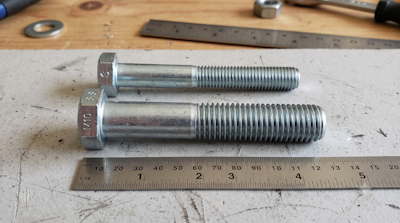
That little mistake sent me down a useful rabbit hole. A #10 machine screw is much closer to an M5 screw than an M10 bolt. An M10 bolt is a much larger piece of hardware. Seeing them side by side made the difference obvious.
With amateur radio, I am being forced to get more comfortable with metric units for distance and antenna measurements. With electronics, metric prefixes show up constantly when talking about volts, amps, ohms, capacitance, inductance, and frequency. With 3D printing, I live in millimeters. With the website, I bump into pixels, rems, and ems.
I was taught the metric system in school many years ago, but I never really used it much until I found hobbies that required it. That is one of the things I like about learning new skills. They do not just teach you the thing you set out to learn. They also expose all the little gaps you did not know you had.
It is funny to me that we still hold out and do not fully convert everything to one system. Maybe that would be cleaner. Maybe it would be easier. But I guess that would make us vanilla, and the world still needs some chocolate.
Until next time, 73 from the lab.
Feedback
Found a mistake or have feedback?
Desert Radio Labs is a learning project. Corrections, better test methods, shared results, and thoughtful suggestions are welcome.
Email: feedback@desertradiolabs.com