A simple non-resonant vertical wire antenna using a 25-foot radiator, counterpoise, four-to-one unun, common-mode choke, coax, and tuner.
Article●Field-Tested
AntennasRybakov
Evidence and limits
●Field-Tested
Used in a real field setting; claims stay limited to the documented conditions.
Observed
The documented portable setup used a DX Commander pole, 25 feet of 14 AWG radiator wire, 25 feet of counterpoise wire, an LDG 4:1 unun, 30 feet of coax, a mix 31 choke, and a Xiegu G90.
The Xiegu G90 tuner found a match from 40 through 10 meters in that setup.
The antenna was used successfully for SSB in the documented outing.
Not measured or uncertain
No other bands were tried during that outing.
Digital-mode operation was intended but did not go as planned.
Very early in my amateur radio journey, while I was still studying for my license, I started researching all the pieces I would need to get on the air. I started with a simple handheld, and that kept my attention for a short time. But what I really wanted was to make contacts across the ocean and around the world. I wanted to be on HF, listening to faraway places and seeing what I could reach.
By the time I took my Technician and General exams together, I had already decided that I was going to buy an HF radio and put up a random wire antenna. I did that, and I was extremely happy with the outcome.
Looking for a Portable Wire Antenna
When it came time to start thinking about operating away from my home station, I knew my 84-foot random wire was not going to work as a portable solution. I started looking for something that would feel similar to what I had in the shack: simple wire, a tuner-friendly matching setup, and enough flexibility to work across multiple bands.
That is when I discovered the Rybakov antenna.
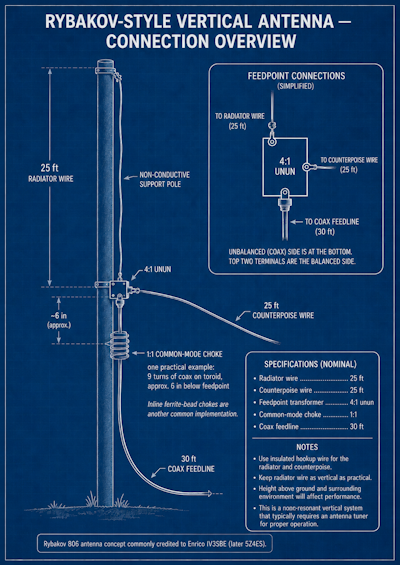
The basic version that caught my attention is simple: a 25-foot vertical radiator, a 25-foot counterpoise, a 4:1 unun at the feedpoint, coax feeding back toward the radio, and a 1:1 common-mode choke on the coax. It is a simple configuration and very portable. A pole makes it easy to deploy as a vertical, but the wire could also be hung from a tree branch if that is what the site allows.
Here is a simple diagram showing the basic Rybakov-style antenna setup:
A Short History of the Rybakov 806
The Rybakov 806 antenna appears to have been developed and popularized by Enrico, IV3SBE, later known by other callsigns including 5Z4ES. The name “Rybakov” is often explained as the Russian word for “fisherman,” which fits the antenna’s early association with lightweight fishing-pole-style vertical supports.
In amateur radio use, the design became known as the “806” because it is commonly described as a non-resonant vertical intended to cover a broad HF range, often from 80 through 6 meters depending on radiator length, counterpoise or radial arrangement, tuner capability, and installation conditions.
The basic idea is simple: use a roughly 25-foot vertical wire, feed it through a 4:1 unun, provide a counterpoise or radial system, and use an antenna tuner to bring the system into range. Like many practical ham radio antennas, the exact implementation varies, but the appeal is the same: a portable, simple, multiband vertical that can be built from ordinary wire, a support pole, a transformer, a choke, coax, and a tuner.
My Portable Setup
I recently tested a Rybakov-style portable setup using a DX Commander pole and 14 AWG wire.
My setup included:
DX Commander pole
25 feet of 14 AWG wire for the vertical element
25 feet of 14 AWG wire for the counterpoise
LDG 4:1 unun
30 feet of coax, with nine turns through a mix 31 toroid near the feedpoint
Xiegu G90 radio with a built-in tuner
The G90 tuner was able to find a match from 40 through 10 meters. I did not try tuning any other bands during this outing.
The antenna performed really well for me on SSB. I intended to try digital modes with it as well, but things did not go as planned. That was a useful lesson by itself: before going portable, test everything you reasonably can before you leave. Once I have mastered CW, I will have another mode beyond SSB to fall back on when things go sideways.
What the 4:1 Unun Does
One thing I am still learning is the difference between ununs, baluns, chokes, and tuners, and when each one makes sense. What I have learned so far is that these parts do not prove resonance or efficiency by themselves. They are part of the matching and feedline system. Their job is to help the radio, coax, tuner, and antenna system work together more predictably.
The 4:1 unun is the impedance transformer at the feedpoint of the Rybakov antenna. Because this antenna is a non-resonant vertical wire with a counterpoise, the feedpoint impedance can vary widely from band to band and will often not be close to the 50-ohm impedance expected by typical coax-fed amateur radio equipment. The 4:1 unun does not tune the antenna by itself, but it helps transform the feedpoint impedance into a range that is usually easier for the coax, radio, and antenna tuner to work with.
In this setup, the radiator and counterpoise connect to the antenna side of the unun, while the coax connects to the unbalanced feedline side. A tuner is still normally required, but the 4:1 unun makes the system more practical as a simple multiband portable antenna by giving the tuner a better chance of finding a usable match.
What the Common-Mode Choke Does
The 1:1 common-mode choke is a separate part of the system. In my setup, the coax wraps nine turns through a toroid near the feedpoint. Its job is to reduce RF current on the outside of the coax shield.
Without a choke, the coax can become part of the antenna system in ways that may affect tuning, increase noise, or put RF where I do not want it. Some operators build this kind of choke with coax through a toroid, while others use inline ferrite-bead chokes covered in heat shrink. The exact implementation can vary, but the goal is the same: keep the feedline from becoming an uncontrolled part of the antenna.
Matching, SWR, and Real-World Use
Because the unun is part of the matching system and does not make the antenna resonant, you should expect to use either the tuner in the radio or an external tuner between the radio and the antenna system. The tuner works with the 4:1 unun to bring the SWR down to a point where the radio can safely transmit.
I know operators are always searching for the perfect SWR, but a simple non-resonant antenna with a good matching system can still produce useful real-world results.
That is what impressed me about the Rybakov antenna. It is not complicated, it is not magic, and it is not pretending to be a perfectly resonant single-band antenna. It is just a practical wire antenna system that is easy to pack, easy to understand, and good enough to get on the air.
A first portable HF test near Flagstaff using a Xiegu G90, DX Commander pole, Rybakov-style wire antenna, and a 15Ah LiFePO4 battery. The station worked, FT8 did not go as planned, and the trip turned into a useful lesson in testing the whole setup before leaving home.
A beginner-friendly explanation of what a 4:1 unun does, how it differs from a common-mode choke, and why it is useful in portable HF antennas like the Rybakov.
Feedback
Found a mistake or have feedback?
Desert Radio Labs is a learning project. Corrections, better test methods, shared results, and thoughtful suggestions are welcome.